Continuous Context at FLiiP
Driving Value Flow and Product Differentiation Through Continuous Context at FLiiP
Thomas Albisser, Chief Operating Officer (COO) at FLiiP

Photo by Andrea Piacquadio from Pexels: https://www.pexels.com/photo/woman-in-gray-sports-bra-holding-black-dumbbell-3757376/
Executive Key Takeaways
Architecting for Value Flow: FLiiP replaced traditional skill-based functional silos with cross-functional value streams grounded in Team Topologies principles, leveraging AI tools to allow multidisciplinary squads to own end-to-end customer workflows.
Continuous Context via Pervasive Capture: To maintain agility during rapid expansion (to double to number of employees), FLiiP instituted a company-wide policy of recording almost all internal meetings, ingesting transcripts, tickets, and CRM data into the Dust AI workspace to democratize organizational memory.
Product Differentiation as Context Stewardship: FLiiP differentiated itself from incumbent category leaders by embedding end-to-end customer context directly inside the platform, enabling gym operators to manage prospecting, sales, billing, and member retention in one unified system.
Operationalizing Autonomy and Alignment: Access to centralized, real-time context empowered autonomous decision-making across teams, shifting management roles from informational gatekeepers to strategic guardrail providers while securing $4M in seed funding based on operational efficiency.
Mitigating Context Decay and Competency Plateaux: To prevent new hires from getting stuck at an "80% competence plateau" or acting on outdated meeting data, FLiiP established dedicated official knowledge bases as single-source-of-truth repositories for AI agents and restructured hiring assessments.
FLiiP: Trusted by 1,000+ gyms across North America and Europe. CRM, billing, a branded app, and AI on one platform, built to bring in members, keep them, and grow your revenue.

Thomas writes:
FLiiP’s Background, Market Position, and Scaling Trajectory
When I reflect on FLiiP’s journey, our mission has always been clear: to empower commercial gym operators and fitness studio owners across North America and Europe with software that drives growth, streamlines administration, and eliminates operational complexity. Founded ten years ago near Montreal, Canada, FLiiP underwent a pivotal transformation a few years ago when we honed our Ideal Customer Profile (ICP) and achieved robust product-market fit. Today, over 1,000 commercial gyms - including premier multi-location franchises - rely on FLiiP as their core operational infrastructure.
Our commercial platform provides an end-to-end solution spanning the entire fitness business lifecycle: member check-in, CRM automation, lead pipelines, payment processing via Adyen, branded mobile applications, and advanced analytics powered by AI churn prediction and automated receptionists. In our category, we compete directly against existing incumbents, most notably the dominant market leader. Where existing vendors offer fragmented, multi-vendor stacks that force gym owners to reconcile disconnected data, FLiiP’s core value proposition rests on platform consolidation, allowing operators to consolidate three disparate systems into one or helping studios recover over 1,040 hours of manual administration per year.
Our strong market traction and capital efficiency attracted tier-one institutional investors. Last year, we closed a $4 million seed funding round. This capital injection was designed to accelerate our product roadmap and AI capabilities. However, as our team expanded rapidly, we recognized that scaling headcount alone could compromise our speed and culture. Rather than bloating our org chart, we chose to invest aggressively in tooling, context sharing, and operational efficiency to preserve our primary competitive advantage: rapid, unencumbered value delivery.
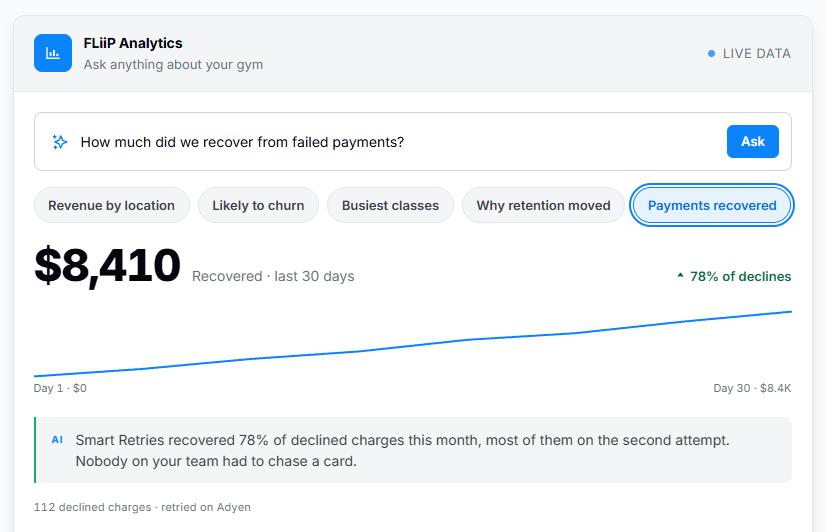
FLiiP analytics - from https://myfliip.com/
Organizational Evolution: Reshuffling into Value Streams via Team Topologies
When our headcount crossed 50, our traditional organizational layout began showing signs of friction. Historically, FLiiP was structured into functional skill silos - for example, Team A handling top-of-funnel onboarding, Team B handling web interface, and Team C managing data - with project managers attempting to translate customer requirements and synchronize handoffs between groups. This layout created classic coordination bottlenecks; teams were optimizing for departmental outputs rather than end-to-end value flow.
Drawing on the principles of Team Topologies we realized that achieving rapid value delivery required restructuring the business around long-lived, stream-aligned value streams. In 2026, I led a fundamental reshuffling of our organization away from skill silos and into cross-functional value streams aligned directly with key customer workflows.
In this new model, we formed multidisciplinary squads ("pods") comprising customer success managers (CSMs), software engineers, mobile developers, product managers, and marketing specialists. This structure was directly unlocked by generative AI and code generation tooling, which bridged traditional skill boundaries. For example, a data analyst in a value stream pod can now comfortably write web UI components or modify API integrations when delivering a feature, rather than queueing a ticket for a specialized front-end team.
The early results of this transformation have been compelling: internal pulse checks revealed immediate increases in cross-skill collaboration scores across our value streams. While cycle times and validation approvals remain our next operational bottlenecks to refine, organizing around stream-aligned teams reduced handoffs and established clear cognitive stewardship boundaries. Based on this success in product and engineering, we are actively preparing to extend these value stream principles across our organization.
Scaling Challenges and the Adoption of "Continuous Context"
As FLiiP grew, we confronted a classic scaling dilemma: as team size increases, natural context sharing degrades rapidly. In a 20-person company, strategic alignment happens organically over lunch or in quick hallway chats. At 50+ employees spread across multiple regions, critical context becomes trapped in isolated Slack threads, private calls, Jira tickets, or CRM records.
We realized that our ability to outmaneuver larger competitors depended entirely on maintaining high organizational context density. Larger competitors move slowly because information takes weeks to filter through hierarchical management levels. If we lost our context sharing, we would lose our speed. Furthermore, introducing AI tools into an organization with functional silos only accelerates the generation of local noise; without continuous alignment, teams simply dump AI-generated artifacts on one another.
To solve this, FLiiP adopted the concept of "Continuous Context": a deliberate, systematic practice of capturing, curating, and diffusing real-time operational and strategic knowledge across the entire enterprise.
I established a firm company policy: by default, almost all internal operational, product, and strategic meetings are recorded and transcribed using automated tools like Fathom. To maintain psychological safety and confidentiality, sensitive board meetings, investor sessions, and one-on-one HR discussions are strictly excluded and held in private workspaces.
Every recorded transcript, alongside CRM leads, support tickets, technical RFCs, and operational updates, is automatically ingested into a centralized workspace on Dust, an AI platform. This creates a living, searchable organizational memory accessible to every employee. After an initial three-month adjustment period where staff adapted to meeting recordings, continuous context capture became an indispensable part of FLiiP’s daily operating rhythm.
“By combining stream-aligned teams, pervasive meeting recording, centralized context diffusion via a unified AI layer, and curated knowledge bases, FLiiP has built an agile, AI-native operating model. We have successfully differentiated our product against legacy category leaders, accelerated feature delivery, improved employee collaboration, and secured growth capital - all while maintaining a lean, highly efficient team.”
Transforming Work at FLiiP Through Continuous Context
The implementation of Continuous Context fundamentally transformed two core aspects of our business: our external market offering and our internal value delivery.
Aspect 1: Product Differentiation via In-Product Customer Context
In the gym management market, platforms routinely claim to provide "end-to-end" functionality. However, most legacy solutions are stitched-together acquisitions where member check-in, marketing automation, and billing systems operate as isolated software islands. This fragmentation forces gym owners to manually transfer data between systems, leading to revenue leakage and poor member experiences.
FLiiP differentiated itself by making end-to-end customer context the core architecture of our product. When a fitness business uses FLiiP, the system retains the complete context of every member and lead across their entire lifecycle—from the moment they click an ad, to automated check-in, contract signing, payment processing via Adyen, and AI-driven churn prediction.
When evaluating FLiiP against incumbent platforms, gym operators immediately recognize this difference. We do not just process transactions; we detect and surface actionable customer context inside the product interface. For example, our AI agents do not merely report past member churn; they detect behavioral changes in real time and automatically trigger personalized retention workflows before the member cancels. By building our software around complete customer context, FLiiP delivers a seamless, differentiated experience that legacy platforms cannot replicate.
Aspect 2: Accelerating Value Delivery Through Operational Context
Internally, Continuous Context revolutionized how information flows across our ways of working, strategic decisions, technical choices, and customer feedback.
Seamless Customer Handoffs: Historically, transferring a newly signed commercial gym from Sales to Customer Success was fraught with context loss. CSMs struggled to understand the specific promises or custom workflows agreed upon during sales calls. Today, onboarding CSMs query our AI layer to review exact transcripts and recordings of sales discussions, ensuring zero loss of context and enabling flawless client onboarding.
Virtual Hypothesis Testing: Before engineering commits a single line of code to a new feature, product squads conduct "virtual tests" against our historical context store. Engineers query Dust across six months of support tickets and customer call transcripts to verify how many gym operators actually requested a feature or experienced a specific bug. This historical data allows us to validate high-impact ideas instantly and eliminate flawed concepts before incurring build costs.
Cross-Functional Problem Solving: When restructuring our customer onboarding flow, we formed a cross-functional pod comprising a CSM, an engineer, a mobile developer, a product manager, and an operations specialist. Working from the same centralized context in our AI layer, this pod redesigned the entire onboarding workflow, empowering business teams to handle migrations autonomously without constantly escalating technical queries.
Achieving Autonomy and Alignment, Investor Validation, and Risk Mitigation
Balancing Autonomy vs. Alignment
A central challenge in modern management is achieving team autonomy alongside organizational alignment, as well as speed with safety. In traditional organizations, executive managers act as information gatekeepers who accumulate context and distribute instructions downward.
Continuous Context completely rewrites this dynamic. By making our full operational context available to every employee through our AI layer, management’s role shifted from controlling information to providing strategic guardrails and empowering decentralized decision-making. Squads operate autonomously because they share the same strategic baseline as the executive team. Leaders intervene only to ensure AI tools do not suffer from hallucinations or to guide teams back toward core strategic bets.
Investor Diligence and Funding
This combination of value-stream alignment and high context density was instrumental in securing our $4 million seed round. During investment diligence, Cultivation Capital and Boreal Ventures stress-tested our financial growth metrics, technical architecture, and operational efficiency. Investors recognized that FLiiP had built a highly scalable, AI-native operating model capable of sustaining rapid revenue growth without proportional headcount expansion, proving that our continuous context approach yields tangible corporate ROI.
Overcoming Teething Problems: The "80% Competency Plateau"
Adopting continuous context was not without operational hurdles. One significant challenge was what we term the "80% competency plateau".
With our AI layer, new hires onboard at unprecedented speed; within days, support representatives or junior developers can query past meeting transcripts and technical docs to answer complex customer tickets or write basic code. However, because AI summaries make it effortless to reach an 80% level of superficial competence, some employees plateaued there, relying on AI-generated answers without developing deep operational judgment or critical domain expertise.
To address this, we modified our hiring and assessment practices. For instance, for technical roles, we shortened the window for code assessment presentations—releasing prompts just a few hours prior to interviews. This setup forces candidates to demonstrate real-time problem-solving, critical thinking, and genuine understanding rather than presenting AI-rehearsed solutions.
Mitigating Stale Context
Another critical risk of continuous context is context decay—the danger that new hires or AI agents might consume out-of-date meeting transcripts or retired strategic decisions from six months prior.
To mitigate information staleness, FLiiP established a clear architectural boundary between ephemeral meeting context and verified organizational truth. While meeting transcripts remain available for qualitative history, our sales, product, and operations teams created separate, curated official knowledge bases. These curated repositories serve as the single source of truth for AI agents computing key performance indicators (KPIs), business metrics, and core operational logic, ensuring that automated systems always operate on verified, current data.
Conclusion and Strategic Takeaways for AI-Native Organizations
FLiiP’s experience demonstrates that achieving sustainable ROI from AI adoption requires far more than deploying LLM chatbots to individual workers. Organizing for value flow through Team Topologies provides the essential architecture, but Continuous Context provides the vital connective tissue that keeps autonomous teams aligned.
By combining stream-aligned teams, pervasive meeting recording, centralized context diffusion via a unified AI layer, and curated knowledge bases, FLiiP has built an agile, AI-native operating model. We have successfully differentiated our product against legacy category leaders, accelerated feature delivery, improved employee collaboration, and secured growth capital—all while maintaining a lean, highly efficient team.
For executive leaders navigating growth in an AI-driven landscape, our key takeaways are clear:
Context is Infrastructure: Treat organizational context as shared infrastructure rather than executive property.
Align Architecture with Value Flow: Replace functional silos with cross-skilled value streams supported by AI tools.
Capture Context at the Source: Record operational meetings and centralize transcripts to build a searchable company memory.
Separate Ephemeral Context from Official Truth: Use continuous context for discovery and collaboration, but maintain curated knowledge bases for AI agents and core metrics.
Evolve Leadership Roles: Shift management focus from informational gatekeeping to setting strategic guardrails and fostering critical thinking.
Authors’ commentary
The example from scale-up gym management solution provider FLiiP is a superb example of first-class technical and operational leadership woven together. With a foundational organizational architecture provided by the Team Topologies approach, FLiiP was able to overlay continuous context in a way that enabled teams to be genuine stewards of value flow. The bold decision to transcribe almost all meetings opened up a rich seam of context that empowers people to make decisions with aligned autonomy.
Matthew Skelton and Renee Hawkins
Techniques used
Team Topologies as a foundation
Continuous Context
Content Infrastructure (as curated knowledge bases)
About the author

Thomas Albisser
As Chief Operating Officer at FLiiP, with over 15 years of experience, Thomas leads Product, Customer Success, Support, and Technology teams to deliver operational excellence and scale the business. His role involves creating a solid operational framework while ensuring customer-centric strategies that drive organizational growth.